Adjusting the Aperture: A Review of Luebbers and Goluboff’s ‘Group Portrait’
By Cara Goldstone
Posted on
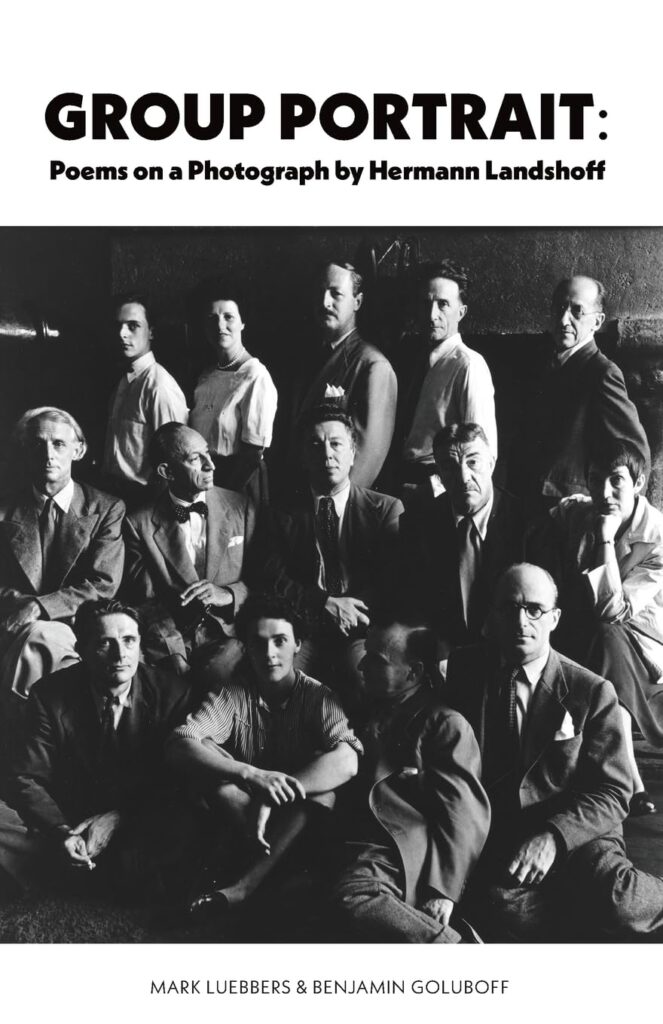
Fresh from Parisian Phoenix Publishing as of July 2025, Mark Luebbers and Benjamin Goluboff’s latest poetry collection Group Portrait: Poems on a Photograph by Hermann Landshoff takes on the ambitious task of tasteful extrapolation; in their examination of Hermann Landshoff’s 1942 photograph “Artists in Exile,” Luebbers and Goluboff aim to highlight the human condition itself as a collaborative narrative composition, not unlike the carefully-ordered lineup of the artists in the picture.
Each of the collection’s fifteen poems balances research and speculation to transport the reader into the mind of a different artist arranged for the camera. Amidst the backdrop of World War II, the various thinkers’ day-to-day social conflicts reflect and foretell cultural concerns that extend far beyond the walls of Peggy Guggenheim’s New York City home, the setting of the portrait. Luebbers and Goluboff weave what is known and what can be plausibly imagined into poetic vignettes that capture each subject’s mind at the very moment the shutter snaps, then place them in unspoken dialogue with each other. Ironic, delicate, and poignant, the juxtaposition of each worldview enforces the theme of the collection: meaning is cultivated, in art and in life.
Group Portrait is preoccupied with authenticity. It gives voice to each of its subjects with intentional distinction, aiming to communicate the internal narrative among the artists as each of them perceives it– ironic, contradictory, and real. The tension between father and son in the
Ernsts’ poems is believable on both ends; the various maternal figures Max allows into their lives complicate the relationship, add scraps and stray pencil lines into the collage of their family tree. Jimmy is verbose, casual, angry. Max is disinterested and pretentious. Peggy, in just three pointed lines, embodies the conflict. None of them understands each other completely; none of them try.
Luebbers and Goluboff structure the poems– and the collection as a whole– with an eye for the unexpected patterns among the group. Marcel Duchamp’s poem is arranged to mimic a chess board. He sees his judgments as logical and calculated; his companions are pieces he can order as he pleases. Opposite the Duchamp poem is that of Piet Mondrian, its lines an arc, the tide and anguish of aging set to a rising and receding flow. Both poems are fixated on making sense of belief: Duchamp needs to feel his imaginary chessboard is justified in its reasonings, while Mondrian considers the difference between justification and simple stubbornness. Later, Stanley Hayter’s piece disperses itself across three pages, disorganized and misty in its lineation. For Hayter, obscurity is easier than self-examination– which makes sense, for an artist of camouflage.
But these patterns, these stories, are speculative; they are real as only imagination can be, hypothesized and projective. Goluboff and Luebbers recognize this. To close Group Portrait, they biographize the photographer behind the title image, Hermann Landshoff, as a collector, an organizer, a sense-maker tasked with the preservation of absolute truth: something he knows is, of course, impossible. He snaps the moment, neatly set in an artificial lineup, and thinks about what art really is, how true it can really be, if that matters, how it will be seen.
Then he takes another photograph, just after the subjects have settled. Like the authors, he holds what’s real, and elaborates.