I wasn’t in love with him, yet. But he gave me that odd little fridge buzz, somewhere inside me – in more than one place inside me, in fact – that made me aware that love was a possibility. That feeling that one’s heart has been replaced with a Victorian mechanical replica; one that still works perfectly well, but now emanates a steady metallic slapping of gears, coarse but warm like beetle wings, sometimes louder, sometimes softer.
I wasn’t in love with him, yet, although my compulsion to invite him to every conceivable non-date activity that I could – anything other than an actual date, naturally – and the icy, terrified delight each meeting brought me suggested that perhaps I was. I couldn’t be, though: we hadn’t even been on a proper date.… ...continue reading
Zeus wears pin-striped togas and storms around his boardroom. He still has an eye for the ladies. At the office, we call him Dad, because there’s a pretty good chance he is. His son, Ares, is a badass. He could pick a fight in an empty room. Another son, Hermes, got caught last year lifting Chuck Taylors from the Parkway Mall. He still works at FTD.
Poseidon lives on Daytona Beach: Hawaiian shirt, flip flops—a Jimmy Buffett type—schmoozing fishermen, posing for tourists. But don’t catch him in one of his moods. He can whip up a hurricane toot sweet—massing thunderheads, crashing waves, the whole nine fathoms.
As for the other members of the Olympus Rod and Gun Club—well, Casio is still the god of bad timing, and Amnesia wooed a meadow by posing as an adjacent meadow but couldn’t remember her original form.… ...continue reading
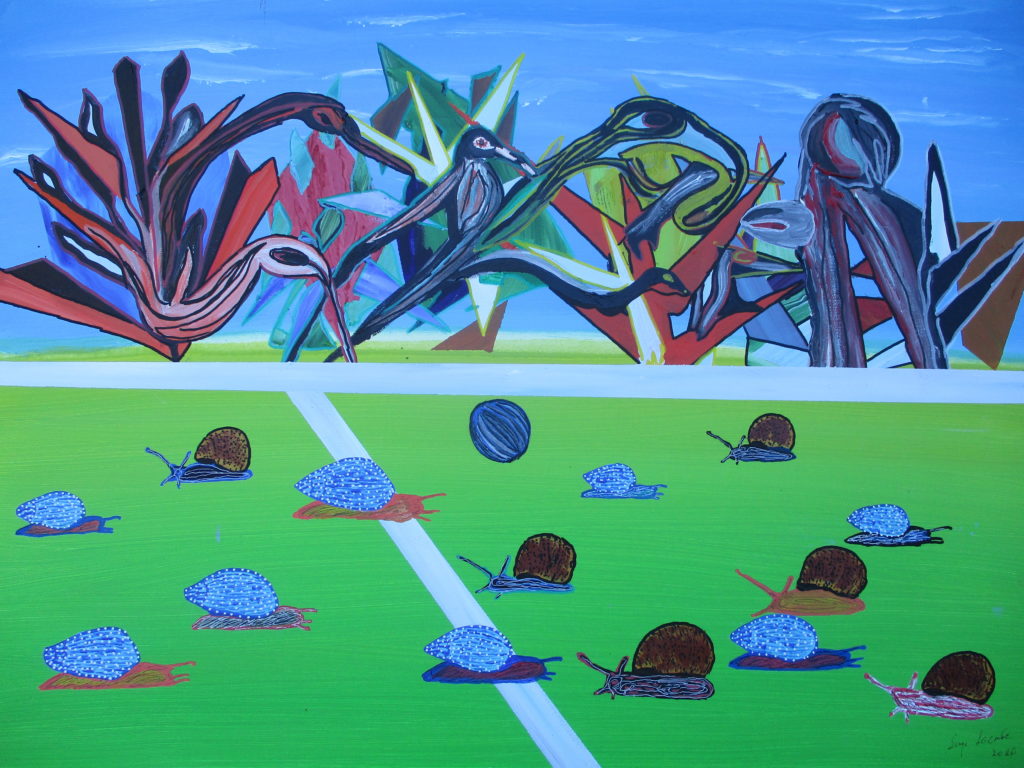
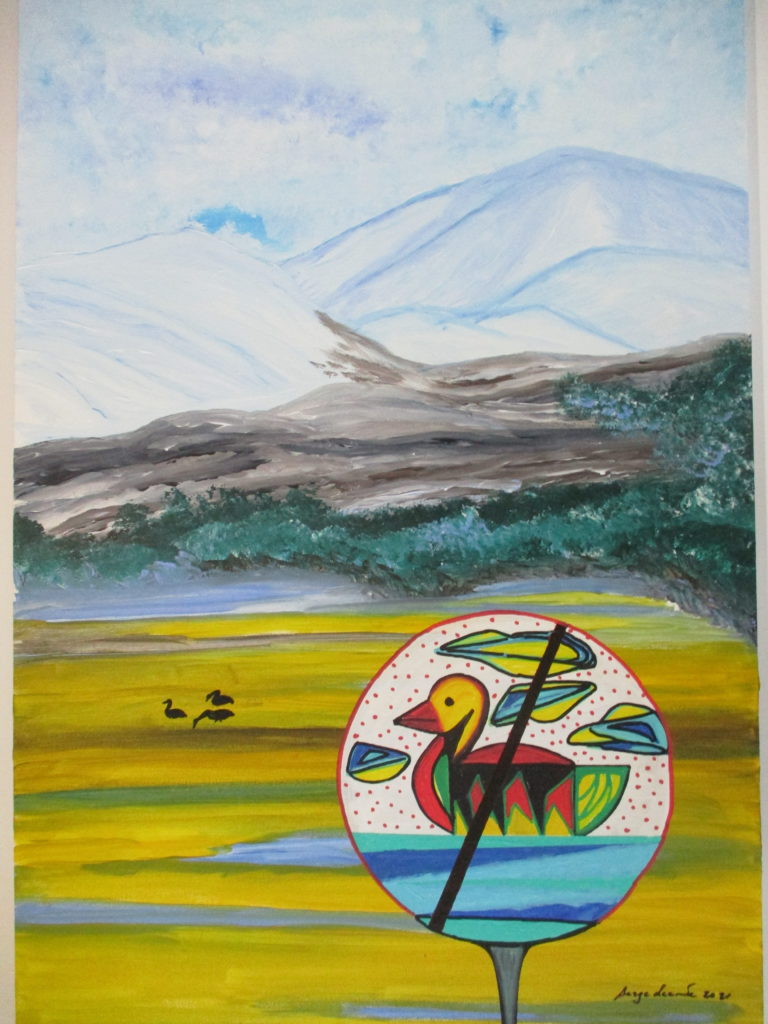
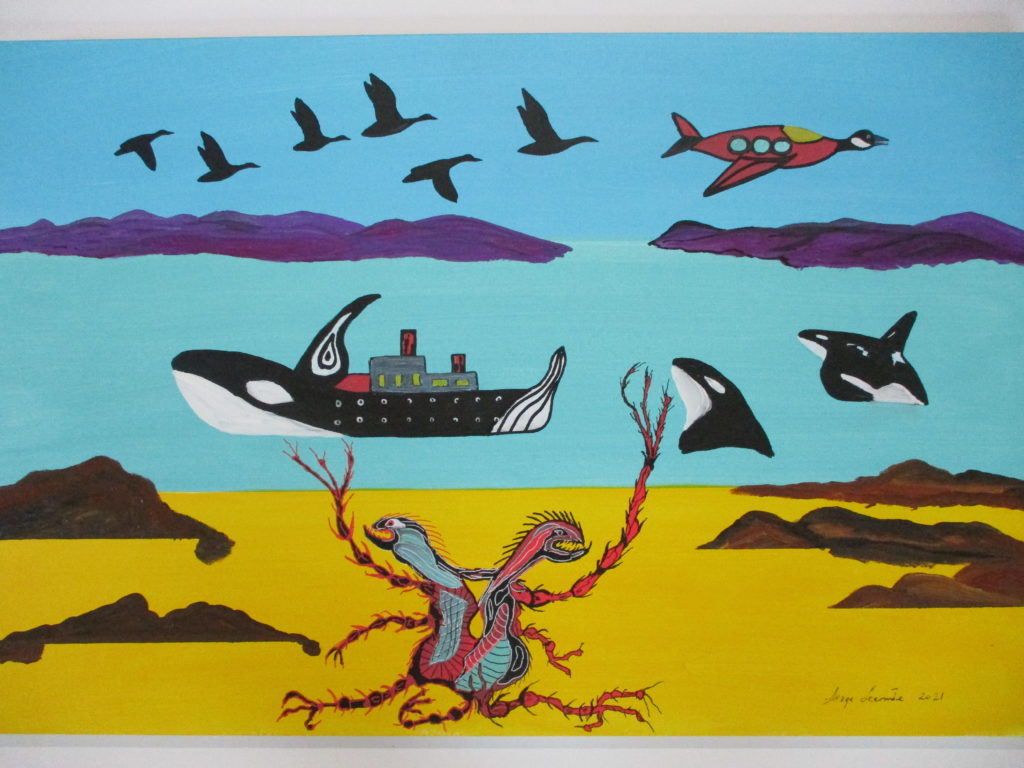
Author’s Note: Serge Lecomte describes his work as eclectic because he is still learning and is willing to experiment with shapes and colors depending on the mood (sometimes contradictory) of the theme he might be working on. The images are a blend of the natural world and imaginary creatures. Some of his paintings have a subtle message, but most do not. Then again, you see what you want to see and hear what you want to hear. … ...continue reading
We escorted the dying woman to a plot of land. Not the land she has been cultivating with wild seeds for the last who knows how many years. No. We walked with her to a plain spot of loose red soil and mountains at a distance.
She was very short, by the standards of the village, but large in the ways women like her seem to grow to be given titles like curandera, mother of us all, high priestess, or maybe even goddess. Whatever it was she did for you would trigger the right title. For she had touched us all in one form or another. She was our center. We gravitated around her like a planet to a star, a hog to his slop, or a bee to the hive.… ...continue reading
All day I had been nervous. Frightened. The whole eastern section of the city remained dark behind locked doors. The uniforms were going street-to-street and door-to-door. Fists pounding. Glass shattering. People crying. Shouting. Intermittent gunshot. The echoes of it all could be heard bouncing from building to building throughout the streets. They had been here earlier tromping through my house unimpeded by anything resembling decency or compassion. They had found nothing and no one, of course, for I had little and lived alone.
I was picking up the scattered bits of broken china left in their wake when there came a tentative knocking on my door. I turned off the lamp and went to the window in hopes of seeing, while remaining unseen, who was there before I committed myself to whatever lay outside.… ...continue reading
When I returned, I held onto the familiar for so long that the changes were only considered slowly, carefully. My cousin, who I met last night for the first time in four years, remarked that it felt as if I had never left. I felt the same, despite knowing the changes in her own life the past few years: a marriage, a move, and a baby.
When I was away I romanticized Lahore to the point of dreaming about it. The bundles of short trees next to the roads, the feral crows on the too-low hanging phone-lines, the bright colours of women’s shalwar kameez: parrot green, mustard yellow, kashmiri chai pink. In my dreams I wasn’t the current me, but younger, looking up at my mother towering over me.… ...continue reading
It’s been drizzling and damp the last few days. I take my chance to walk a few blocks and visit a pond I’ve gotten to know. Most of the streets around the city are tidy, controlled. The people wear shoes all the time. City dust is a sad smell. I feel heavy from a week of work. My shoulders are a mess of neat concrete knots. My feet slip around in my wet thongs. Something small and brown flitters across the footpath in front of me, into a restrained, tasteful, potted buxus. The street sweeper will swing through later tonight, but for now the damp leaves in the gutters glitter in the sun. A shiny car parallel parks in the distance, but otherwise the road is empty.… ...continue reading