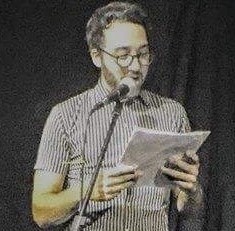
Frank Jackson is a short story writer living in Brooklyn, published in journals including Shabby Doll House, Four Chamber Press, X-Ray Literary Magazine, and Have You Seen My Whale.
In this episode of Cover to Cover with . . ., Editor-in-Chief Jordan Blum speaks with Jackson about his fiction piece “Brunch Warriors,” the power of satire in creative writing, the pros and cons of “cancel culture,” some favorite musical genres and artists, and much more!
I have always been great at lying and I rarely, ever, get caught. I studied the masters for decades and concluded that I would join their ranks without fanfare or notice. I became an expert by process of elimination. I deflected lie detector tests, ex-girlfriend’s scrutiny, and initial employment background checks. Never caught once. When Shakespeare told me, “the eyes are the windows of the soul”, I closed the curtains to avoid a baseline examination of the real me. That is the truth (pause for a Falstaff laugh) to being a great liar. NEVER LET ANYONE KNOW WHO THE REAL YOU REALLY IS!
All lie detection methods are based upon one or more of three basic principles as follows:
1) Physiological response (increased blood pressure, increased body temperature, change in galvanic skin resistance, etc.)… ...continue reading
The body appeared on the fourth of October. I remember, because Lucia had suddenly decided to break up with me the night before, but also refused to leave our apartment, and didn’t want, in her words, to “force you to leave, either.” So, we were stuck in a cat and mouse game of who could tolerate sleeping in the same bed longer, until one of us discovered the humility to find a new place to live. It was a big apartment with wood floors and exposed brick, and all for pretty cheap, too. I wasn’t going to give in.
Everything about the place was great, spare the apartment building next to us. We could easily look into the apartment parallel to ours—and hence, they could look into ours.… ...continue reading
One thing I learned fast being married, he advised over lunch, is that we can’t share toothpaste. For 42 years I’ve rolled mine up, nice and neat, while she can’t even manage to cap the lid.
The entire conversation I imagined them standing
divided at their bathroom sinks. And when the talk
turned toward other rooms, I tried not to follow–
too young and new to understand anyhow.
I heard a story as a child
of a farmer gifted a purse
that never emptied of coins
and of a widow from the Bible,
her oil and flour that never emptied
of Elijah’s promise from God.
We usually brush our teeth to give
the other a polite hint, to
not ruin the mood.
And against all upbringing and experienced advice
I keep the damn lid open ………………………………………………..… ...continue reading
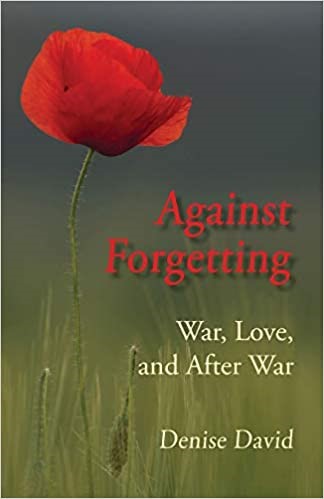
Against Forgetting: War, Love, and After War – Denise David
The year 2020 marks seventy-five years since the end of World War II; Denise David’s Against Forgetting: War, Love, and After Waris a poetry collection about people living the war—a legacy of first-hand memories preserved by a researcher scholar, the daughter of a war bride.
What is your literary background and education?
I am a teacher and a writer. I taught writing and literature for over twenty-five years at a community college in upstate New York. As meaning-making creatures, our stories help us understand who we are and allow us to make sense of the world. My formal education includes earning a Ph.D., but I have never stopped learning from my students and from my own writing.… ...continue reading