Turning Time into Words: A Review of ‘1000 Pieces of Time’ by Michael Minassian
By Peter Mladinic
Posted on
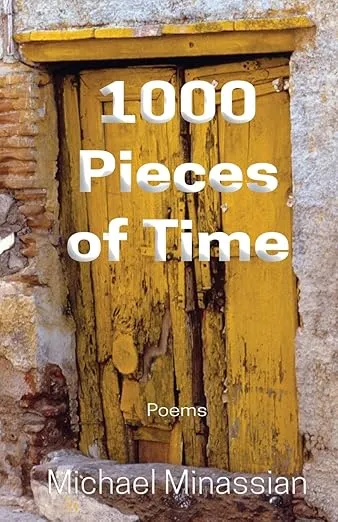
The title 1000 Pieces of Time provides insight into the author’s concerns: time, mortality, and imagination.
Clock time goes forward. A person is born and dies in clock time. What to do faced with the inevitable? The poet confronts mortality with imagination. His speaker finds beauty, Botticelli’s Venus, on a travel poster in a window on a block of boarded up stores. Venus looks downcast, “as if she knew / how beauty could be stolen / how winter always crushes spring.” With imagination a child, Mary, teaches a rooster to walk backwards in “Walking Backwards.” Today she is immortalized in her stories, in a book titled The Complete Stories, by Flannery O’Conner. “The Sweater,” is set in the present. The detail of “a thread unraveling / on the sleeve of a shirt” evokes a poignant memory of the poet’s grandmother’s life. She immigrated to the United States at the turn of the Twentieth Century and worked as a seamstress in the garment industry. One thinks of time as a journey; the poet’s and his grandmother’s converge in these succinct stanzas:
A survivor of the Genocide,
she walked through the desert
from Armenia to Lebanon
before coming to America.
At her funeral, I sat
holding her favorite sweater,
a worn wool cardigan
I brought home
from the hospital,
the top two buttons
missing, as absent
as her voice.
All are subject to felt time. Such is the case in “Silver Alert.” A woman’s father, a senior citizen, is missing. Alone at home, Cordelia is “watching the video clip / of her plea for her father’s / safe return.” One senses her acute anxiety. “She thinks to herself: / too much time has passed—.” “Elysian Fields” references Albert Einstein, Sir Isaac Newton, the game of baseball, and the catastrophic tragedy of “the bomb” dropped on Hiroshima. In “Come Early, Leave Late,” arriving early at a funeral, the speaker is “out of sync with time.” His clipping “a lock of the corpse’s hair,” is perhaps an effort to stave off mortality, just as the poet’s effort to stave off mortality is in the making of the poem. This effort is evident in “The Waitress.” In the poem’s second half:
Though the plate glass
window we could see
a shelf of sunlight
rearranging itself
along the horizon
in an intimate gesture
reminding us of other
stories we might tell
outside this place
Imagination is alive and well throughout the book, especially in poems with a context in historical time involve bringing the past to present, mostly but not always, in the form of noted figures from the past. Achilles appears as a subway commuter, “giving up / his seat to an old / woman” in the opening poem. Timing, in“Christopher Marlowe Buys Me a Drink,” makes for subtle, yet outrageous humor. Two people are seated at a bar. By observing key details: “hat pulled down low / a clipped British accent, one thinks he recognizes the other. “Christopher Marlowe? I ask.” This is outrageously funny, right in the middle of poem, and all because of the question’s timing. Similarly, in “Emily at the Waffle House,” the image of Emily Dickinson “as a waitress …wearing a Boston Red Sox / baseball cap” is outrageously funny. Amelia Earhart, Helen of Troy, Charles Darwin, Charles Dickens, and the tyrannical (head of) Oliver Cromwell step out of the past into the present in poems born from the poet’s drive and delight. These historical time poems are as imaginative as they are skillfully crafted.
One poem with a basis in history does not involve a historical personage, but, like the aforementioned “Elysian Fields,” brings together the seemingly disparate elements of baseball and war. This poem is “The Sweet Spot (1962-1972).” The core of this unlikely combination is rendered in a simile. “The Greeks invented …the phalanx: / a rectangular battle formation / turned on its side, / diamond shaped / like a baseball infield.” This poem, in third person, has the tone of a biography unfolding in historical time. “In Saigon, he wanders / …who won the World Series?” These lines suggest the gulf between the innocence of childhood and the corruption of war. In the fallen world of wartime Vietnam, he is far removed, not just geographically, but in every way from the baseball days, where, “on the front porch” he starred into “the palm / of the baseball glove.” From the front porch of home, he is transported to the streets of Saigon, where, perhaps in a cafe, he reflects, “Was it really better / to be red than dead?” a reversal of the slogan “better dead than red.”
Remembering how he felt that day:
feeling summer coming on,
trying hard to compare
the heat in Vietnam
to the sound of the bat
as it hits the ball:
the sweet spot, they say,
hoping it’s enough to stay alive.
When ball meets the bat’s sweet spot, the batter hopes the ball will stay airborne, stay alive, long enough for the hit carry into the stands, to be a home run. Luck and chance are involved, just as they are for a soldier embroiled in the war in Vietnam.
Michael Minassian comes at time (and mortality) from every angle. In the early 1960s, the poet Philip Larkin wrote the line “Days are where we live.” In the early 1970s, poet Michael S. Harper published a book of poems titled History Is Your Own Heartbeat. Today, poet Michael Minassian has given time a contemporary face. In “Bruised Flowers” he shows and tells:
The hummingbird
outside my window
appears to hover
in front of the orchid
its four chambered heart
beating twelve hundred
times a minutes.
His being alone with language has made these poems memorable in 1000 Pieces of Time.