I doff my heels, unbutton my collar, and eat at my picture window.
My last promotion, they were surprised when I chose this 5th-floor office. A non-corner-office; furniture outmoded; and so low! I said: ‘I have acrophobia.’
I couldn’t say: ‘I want to look, one last year, out of the eyes of the beast.’ This picture window looks into the slum across the road.
The men are coming home for lunch. From where? From that corner. Beyond that corner, my picture window doesn’t see. The men are mostly autorickshaw drivers.
Some of the young men, who’ve acquired broken English, work as shop assistants. They don’t come home for lunch.…
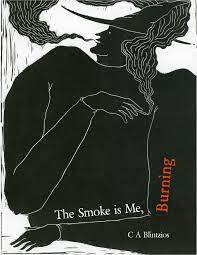
The Smoke is me, Burning by Constantine Blintzios, is the story of a family surviving on the edge of a pine forest in Harmswood, Arkansas. Crops have been corrupted by an outbreak of parasites in the rye. Livestock and buzzards alike are dying, so decay is left to spread unchecked. Blake and Jamie Ackerman have grown up on the lip of these woods. Raised by an alcoholic mother and a Vietnam-war veteran uncle, they have grown up believing in gods beyond the chicken-wire fence of their backyard, gods that steal children from their beds. When they are little, Jamie sees something in the woods and blinds his brother in one eye to keep him from seeing it, too.…
Picture sky, its timeless entirety: north, south, east, west, directions encompassing life beneath it, existence through it, eternal bird species know best, returning flock after flock, if not driven to extinction, the air, everywhere, ground of hunt.
This horizon, for now, does not seem to have that, bluing more pearlescent with less coal smoke & oily carbon exhaust poking ozone holes for blazing rays in separate glory, shaft by shaft. Behind that the perfectly burning circular sun grants photosynthesis or fires wild as if humanity has nothing to do with this present as early on stoves were for wood & the heaping of peat, the past air so pure lungs sung with oxygen glistening from valleys and glades, deserts and alps.
Imagine this kitchen window here having such painterly sheen, all interior surfaces dust-mote gleaming to the richness of shadows while in close-up particular hands on a bread board pound & shape dough.…
Once at the county fair a foreigner—a Russian with an elaborately waxed yellow mustache—was selling wooden dolls, cleverly made so that they seemed to be only one doll, pear-shaped and gaily painted, but inside each peasant woman was a similar doll except slightly smaller; and inside her a similar doll; and insider her; and inside her . . . six altogether, the smallest representing a peasant child, a brightly smiling infant.
Nord thought the dolls were the cleverest woodworking he’d seen. He bought one for Peggy, but she didn’t seem to see the cleverness—maybe because, being a woman, she’d never worked wood so therefore couldn’t appreciate the skill such a set of dolls required.
The dolls were kept, one inside the rest, in a cabinet in the parlor.…