“So who’s the father?” her mother asked, combing Paulette’s wet hair.
“We’re married, Mama.”
“But who is he?”
“If it matters Mama, he’s a good man, and he comes from a good family.”
“A college student?”
“An ex-college student.”
“And you said you’re married?”
“Yes, Mama. We had our own rites.”
“But this wasn’t a church, or a court wedding.”
She raised her eyes to the mirror, where she met her mother’s blank gaze.
“I’m not questioning the wedding itself, Paulie. You’re clearly in love with this boy. But you’re home, and I’m guessing he’s in the mountains, fighting. Do you really want to return to that, now that you’re going to have a baby?”
This was how their fights usually started: with her mother pretending to respect her.…
He knew it all as soon as he heard the scream. She ran up from the barn, screaming, crying. He knew what it was, knew what he would have to do before she reached the house, knew even as she sprinted through the back door, kicked off her sandals, bypassed her Mama in the kitchen, and screamed, Daddy! Daddy! A snake at the barn! that he would have to kill it.
He sat shirtless in his armchair. It was Sunday. He worked mornings at Foster’s, came home for lunch, slept for an hour, and attended church in the evening. Unless, of course, his relief was late, or problems at home intervened. Either way, come six o’clock he’d be at the church; and for this reason, he regretted his daughter’s screaming in the living room.…
Philip stared at his computer screen, at row on row of black words stretching across the white page, the first of eighty. Some Ph.D. in chemistry from Lexington wanted his paper edited so that it made sense. The company Phil worked for had six months’ worth of projects stacked up for him. They paid well.
Yet each morning he sat in his bathrobe at his desk and stared out the bedroom window at the cold Pacific breaking along the strand. He struggled to concentrate, felt like a clump of dune grass rooted in place but whipped by emotion. Susan and the past two years flooded his mind.
In the kitchen, his mother fixed his breakfast, father already off to work at the Pharmacy. Philip grabbed his coffee mug and shuffled toward the aroma of French toast and fresh-brewed Brazilian.…
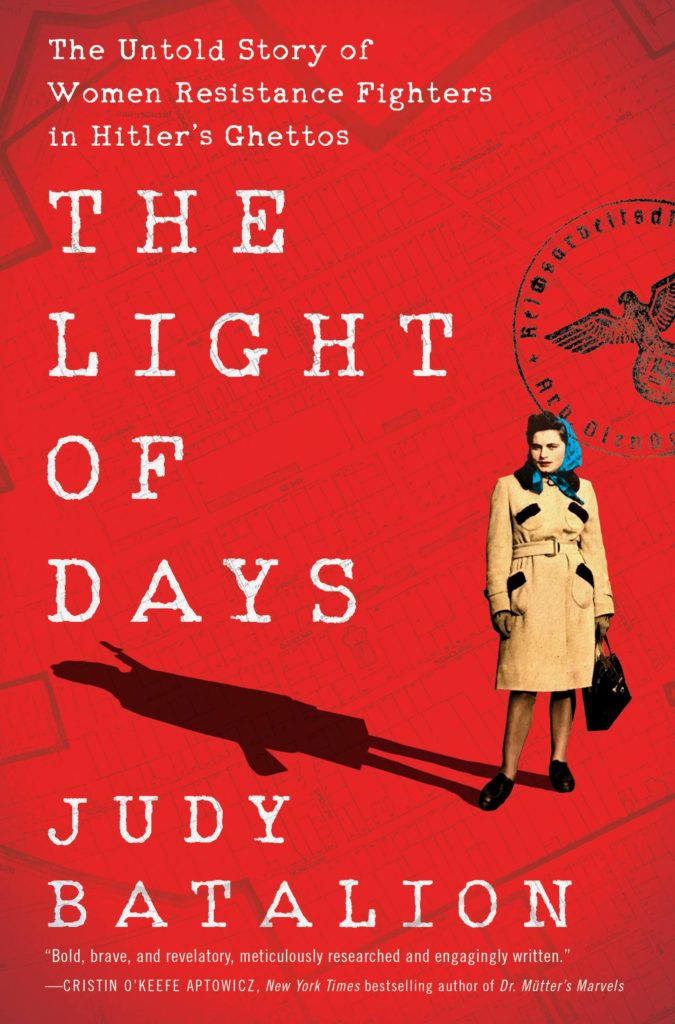
Some stories are just too amazing not to be told. In Judy Batalion’s Light of Days: The Untold Story of Women Resistance Fighters In Hitler’s Ghettos, she uncovers the incredible stories of brave young women during the Holocaust. In the midst of horror, these women banded together and formed a deadly militia in which they called themselves, the “Ghetto Girls.” The book begins with a powerful and heartbreaking quotation taken from a song about the Warsaw Ghetto uprising and written by a young Jewish girl before her death: “With graves on street corners, Will outlive her enemies, Will see the light of days.”
The women in Light of Days had unwavering courage that allowed them to choose the more difficult and honorable path, to fight the Nazi regime.…
O, what a face full of things: With cigarette in mouth and with fear Sometimes transparent tongues of heat at my thighs—
Such longings: Errant. Verdant. Yes, when the signs of summer thicken, like bees, and I lap at your sides. Give darkness an inch.
Thus I: faltering forward, endlessly. Your voice on the telephone. I mean the bees in my body are restless again and set out to find you.
(lines from A.D. Hope, Roberto Bolaño, S. Ben Tov, Seamus Heaney, C.D. Wright, Rudyard Kipling, May Swenson, Albert Goldbarth, Thomas Hardy, Margaret Holly, Paisley Rekdal, Yehuda Amichai)
The worst heatwave on record arrived the summer I turned nine. It showed up on a Sunday morning, like a traveling evangelist preaching fire and brimstone. Even the air was angry. The sky bruised over in grey and green, but rain never came. My mother opened all the windows to try and catch a breeze, even the one in my bedroom, where the screen was torn and gaped open like the mouth of a jack-o-lantern. It didn’t help much. Carrie had already asked twice if we could turn down the A/C.
“It’s not working right now. My mom said she’s going to call someone tomorrow,” I smiled.
The lie was almost a reflex. Born of my knowledge that Carrie’s house shivered with artificial air in the summer.…
So mastered by the brute blood of the air, Did she put on his knowledge with his power…? —W.B. Yeats
On the last day of high school, I went into the alley to say goodbye to Big Al. It was late afternoon, lowering clouds, the sort of sky Mom had always called “the farmer’s friend.” Jimmy Collins—Jim, as he’d been insisting I call him since October, but I liked Jimmy, name and boy, because it contained “my Jim”—Jimmy had told me the word for that atmosphere: crepuscular. We gifted each other new words like treats. I’d said crepuscular sounded like an unseemly growth, it even has puss in it. Jimmy liked that but gently mocked, “Unseemly, eh?” and pretend-punched my shoulder.…