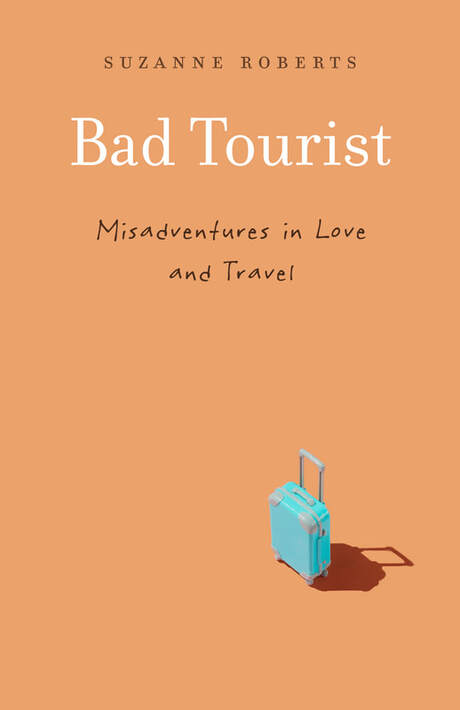
As a student in the Sierra Nevada University MFA program, I recently got to sit down with Suzanne Roberts to discuss her latest book, the memoir Bad Tourist (University of Nebraska Press, 2020). Beyond being a writing instructor, Roberts is an accomplished travel writer, named “The Next Great Travel Writer” by National GeographicTraveler Magazine. Her previous book Almost Somewhere: Twenty-Eight Days on the John Muir Trail (Bison Books, 2012) won the 2012 National Outdoor Book Award. Roberts has also published four volumes of poetry.
Even though I have had classes with Roberts and have attended literary events where she was in attendance, until I read Bad Tourist, I can’t really say that I knew her. To be honest, she intimidated me: she is a demanding instructor, and while friendly, she is unabashedly forthright.…
David Colodney is the author of the chapbook Mimeograph (Finishing Line Press, 2019). A two-time Pushcart nominee, his poems have appeared in South Carolina Review, Panoply, Gyroscope Review, and The Chaffin Journal. David holds an MFA from Converse College, and lives in Boynton Beach, Florida, where he serves as Associate Editor of South Florida Poetry Journal.
In this episode of Cover to Cover with . . ., Editor-in-Chief Jordan Blum speaks with Colodney about Mimeograph, how father/son relationships impact us in general, his upcoming poem (“Turnstiles”), music, and much more!
In my backyard—at night there is a mirror— the American river I walked to the outcropping where they once tried to build a bridge
Remember how I taught you to throw stones here? The angle of your elbow to skip the smooth rock… 1, 2, 3, 4 The ripples of each skip’s epicenter
The sky is a fusion between the living and the dead, as the sunset was fifteen minutes ago
Coyotes howl like a heart skipping stones among ghosts
I feel the years of a rock worn smooth against my fingers delicately kissing the flesh I used to trace over your body, watching the shadow’s outline each ripple in the unmade bed
The stone falls from my waist I don’t care to catch it Clank echoes as the rock abides to the law
This new stone I grab isn’t smooth at all, the edges remind my fingers of broken glass, of after the end of a fairytale and is swallowed by my palm
The rawness is a challenge to skip amidst the clamor of trees in the delta breeze, my only audience
I submarine my hand beneath the elbow chock my shoulder Leaves rustle in anticipation
The sky dies after I cut the tension, flinging the stone into mirror broken glass cascades down the bathroom vanity It falls into the tops of my feet
Where I can no longer see myself I hear all the leaves fall in applause
I am four / and the generator giving us heat has been ruined / by a quiet susurrus / of snow / my mother leaves for help / my father’s whereabouts unknown / I venture out into the white / into the white darkness / barefoot and determined / after five minutes my toes go leather / my eyes harden and scan blankness for life / I’m almost to the neighbor’s house when a deer and her fawn / leap from the drowsing maples / to my right / I stop unsure of the danger / they stop / curiosity overriding fear / I reach out / their two bodies steaming / one cloud of life and / when our eyes meet / I feel something / close to truth / or the first edenic moments / before the fall / then in the space of exhalation / all that remains is the drifting / of snow / pin-pricked with hoofprints / a mother perplexed / and reaching
As a registered caffeine addict, I’m more than a little bewildered by anyone over the age of twelve who doesn’t drink coffee. I’m with Michael Pollan, whose recent audiobook, Caffeine, explores not only how the world’s most widely used psychoactive drug has taken over our lives but also tells how he tested his own reliance on caffeine by giving it up for three months. Pollan slept better, he says, but his brain power flagged and his productivity declined, so he went back to the stuff.
As for myself, well, I’m glad that somewhere around the year 850, an Ethiopian goatherd named Kaldi noticed that when his charges nibbled the berries of a certain plant, they gave up the foxtrot, waltz, and mambo forever and began to do the twist, frug, swim, hitchhike, monkey, slop, Watusi, pony, shake, jerk, stomp, shag, and mashed potatoes.…
Annabelle Lee had a room of her own, wallpaper from the movies, and an iPhone. She had a closet full of clothes, many with price stickers still on them; she had one favorite sweatshirt, hidden in the corner so that Mariana, the cleaning lady, would not put it in the wash. Annabelle Lee swore that the sweatshirt would never be washed because she wore it the day the seventh-grade boy with the thick silver chain asked her for a cigarette by the fountain; she did not have one, but the moment lasted anyway. On top of it all, Annabelle Lee had a porcelain doll; she had other dolls, too, but the porcelain doll was her favorite, though she never gave it a name, but just called it “my doll.”…